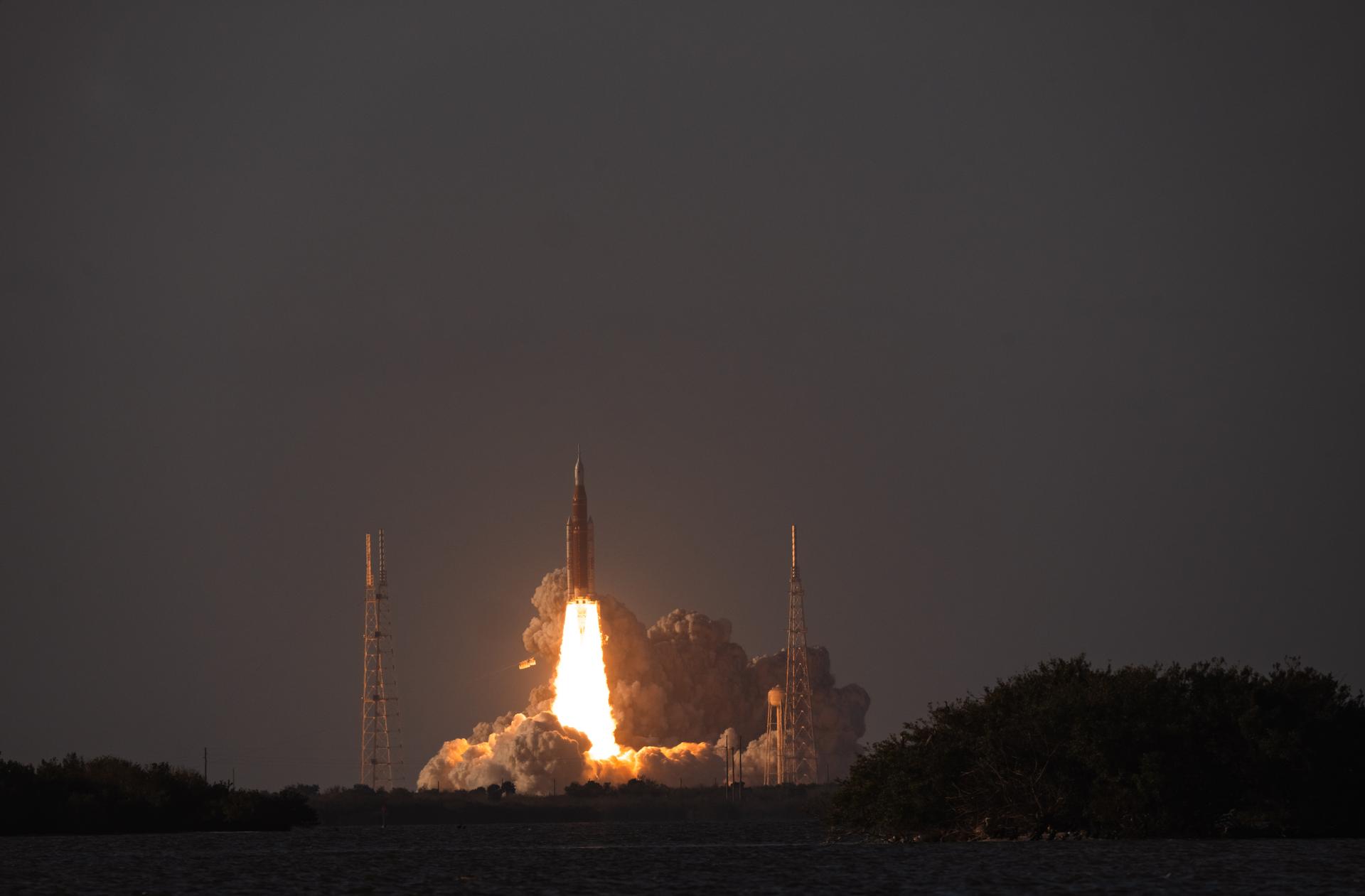
NASA's Space Launch System rocket carrying the Artemis II crew lifts off from Kennedy Space Center, Florida, on April 1, 2026. (Photo: NASA/Steven B. Seipel, public domain)
Four astronauts flew farther from Earth than any human being in history — and then they came home. That is the short version of Artemis II, which launched on April 1, 2026, looped around the Moon, and splashed down in the Pacific nine days later.
It did not land on the Moon. It was never supposed to. Artemis II was a test flight, and it passed — which is why the real question now is what happens next. NASA has reshuffled its whole Moon plan, the next crew is already named, and the first Moon landing in more than half a century has a new date. And the crew saw something no human eyes had ever seen.
Artemis II at a glance
| Launch | April 1, 2026, 6:35 p.m. ET — Space Launch System rocket, Launch Complex 39B, Kennedy Space Center, Florida |
| Crew | Reid Wiseman (commander), Victor Glover (pilot), Christina Koch and Jeremy Hansen (mission specialists) |
| Mission length | 10 days — April 1 to April 10, 2026 |
| Farthest from Earth | 252,756 miles (406,771 km) — a new record for human spaceflight |
| Closest to the Moon | 4,067 miles (6,545 km) above the surface |
| Splashdown | April 10, 2026, 5:07 p.m. PDT, Pacific Ocean off San Diego |
| Total distance flown | 695,081 miles (1,118,624 km) |
When did Artemis II launch?
Artemis II lifted off on Wednesday, April 1, 2026, at 6:35 p.m. Eastern Time, from Launch Complex 39B at NASA's Kennedy Space Center in Florida. The rocket was the Space Launch System, or SLS — the most powerful rocket NASA has ever flown — carrying Orion and its four astronauts.
It was the first time astronauts had flown beyond low Earth orbit since Apollo 17 came home in December 1972. For 53 years, every crewed mission had stayed close to Earth, mostly at the International Space Station, about 250 miles up — Artemis II went roughly a thousand times farther.
The uncrewed Artemis I test flight in November 2022 had already proven the rocket and spacecraft could fly to the Moon and back. Artemis II was the next step: the same journey, this time with people on board.
Who was on Artemis II?
Four astronauts flew on Artemis II, and each of them made history just by being there. Commander Reid Wiseman led the mission. Pilot Victor Glover flew the spacecraft — the first person of color ever assigned to a mission to the Moon. Mission specialist Christina Koch is the first woman assigned to a lunar mission. Mission specialist Jeremy Hansen, from the Canadian Space Agency, is the first non-American to travel to the Moon.
That mix was the point: Artemis is an international program, and Hansen's seat was Canada's contribution. For ten days, the four shared about 330 cubic feet of living space — NASA compares it to two minivans — with a toilet behind doors for privacy, something Apollo crews never had, and a menu of 189 food items.
How far did Artemis II go — and what record did it break?
On April 6, 2026, four days in, Artemis II passed a distance record that had stood since 1970. At 12:56 p.m. Central Time, Orion moved past 248,655 miles from Earth — the mark set by Apollo 13 during its emergency trip around the Moon.
The crew kept going, reaching 252,756 miles (406,771 km) — about 4,100 miles beyond the old record. No human being has ever been farther from home. The point was to prove Orion's life support, navigation, communications and heat shield could keep four people alive in deep space and bring them home.
NASA's other great distance story is uncrewed: Voyager 1, the farthest human-made object from Earth, recently crossed one light-day from our planet. Artemis II is the human version of that achievement: the farthest people have ever gone, and the farthest they have ever come back from.
Did Artemis II land on the Moon?
No — and that surprises a lot of people. Artemis II never landed, and it never entered orbit around the Moon either. Orion flew what NASA calls a free-return trajectory: a big loop around the Moon that uses lunar gravity to swing the spacecraft back toward Earth.
At its closest, on April 6, Orion passed 4,067 miles (6,545 km) above the lunar surface — close enough to see the Moon in stunning detail, but far too far to land. Artemis II was a test flight: its job was to prove the spacecraft works with a crew before anyone tries the far harder job of landing. A flyby that proves the ship is safe is worth far more than a rushed landing.
What did the astronauts do for 10 days in space?
Ten days sounds like a long time in a space the size of two minivans, but the crew was busy from launch to splashdown. NASA says they tested the life support systems, practiced manual piloting, used the exercise equipment, checked the emergency equipment and worked in their spacesuits.
They were also the mission's photographers, taking more than 7,000 photos of the lunar surface. There was the everyday business of living in space, too: sleeping in shifts, eating from that 189-item menu, and exercising to keep muscles and bones strong. On the far side of the Moon, Orion briefly lost contact with Earth, as expected — the Moon itself blocked the signal — and regained it about 40 minutes later.
What did the crew see that no human had seen before?
Here is the payoff to the promise at the top of this article: during the flyby, the crew became the first people in history to see parts of the Moon's far side with their own eyes. Every astronaut before them had only seen the side that faces Earth.
They also watched an Earthset — the Earth sinking below the Moon's horizon, the mirror image of a sunset, but with our whole planet sliding out of view. As Orion looped around the Moon, the crew also saw a solar eclipse from space: the Moon passing directly in front of the Sun. In one photo, the dark Moon hangs against the glowing Sun, with Orion's solar array in frame — and, NASA notes, the bright spot just below the Moon's edge is Saturn. Another favorite image shows a crescent Moon and a small crescent Earth side by side against black space, taken just before Orion slipped behind the Moon and out of contact.
What happens next? Artemis III explained
This is where the story changes. On March 3, 2026, NASA announced a new architecture for the Artemis program — and Artemis III, originally supposed to be the first Moon landing, is no longer a landing at all.
Instead, Artemis III is now planned as a crewed test flight in low Earth orbit, targeted for 2027. Four astronauts will launch in Orion on the SLS rocket, while test versions of the commercial Moon landers — SpaceX's Starship and Blue Origin's Blue Moon — launch separately, and Orion practices approaching and docking with them. In NASA's detailed plan from July 15, 2026, Orion will first dock alongside Blue Origin's Blue Moon test lander — up to two astronauts may open the hatch and go inside — then dock nose-to-nose with SpaceX's Starship test lander, which the crew will not enter.
The idea is simple: practice docking close to home, where a problem is manageable, before trusting the landers on the Moon. The crew is already named: commander Randy Bresnik will lead the mission, with Luca Parmitano of the European Space Agency as pilot, and Andre Douglas and Frank Rubio of NASA as mission specialists. Bob Hines is the backup. The hardware is already being built — the Artemis III SLS core stage was lowered into place in the Vehicle Assembly Building at Kennedy Space Center on May 4, 2026.
When will astronauts land on the Moon again?
The first Artemis Moon landing now belongs to Artemis IV, targeted for early 2028. NASA's Artemis IV page, updated September 1, 2026, says the crew will fly to the Moon in Orion, transfer into a commercial lander for the trip down, and return to Orion in lunar orbit before coming home.
Which lander will carry them has not been decided — NASA says lander readiness will decide whether SpaceX's Starship or Blue Origin's Blue Moon takes the crew down, and the Artemis III docking tests in 2027 are meant to settle that question.
After that, NASA expects Artemis V, another landing, by late 2028, then about one mission a year and work on a Moon base. These are targets, not promises — space schedules move. But the direction is clear: test the landers in 2027, land in early 2028, and keep going.
It has been more than 50 years since the last person walked on the Moon. Apollo 17's Gene Cernan left the surface in December 1972. If Artemis IV holds its date, the next footprints will come about 55 years later — at the lunar South Pole, a place no human has ever visited.
What does Artemis II mean for a trip to Mars?
Artemis is not only about the Moon. NASA says the program exists to send astronauts back to the Moon and to prepare for the first crewed missions to Mars. Everything Artemis II tested — keeping four people alive for ten days far from Earth, navigating in deep space, steering by hand, surviving a high-speed return — is something a Mars crew will need too.
Orion came home at nearly 35 times the speed of sound, parachutes slowing it to under 136 miles per hour and a splashdown at about 20. A spacecraft returning from Mars will come home even faster — and the heat shield that survived Artemis II will have to survive that, too.
The bottom line
Artemis II did exactly what it was supposed to do. It took four astronauts around the Moon, farther from Earth than anyone has ever been, tested the spacecraft that will carry the next crews, and brought everyone home safely — breaking a record that had stood since 1970 and photographing the Moon's far side with human eyes for the first time.
What comes next is a test flight in 2027, and then — if the plan holds — boots on the Moon in early 2028. For the first time in more than half a century, a Moon landing has a date, a crew in training, and a rocket already being built. The Moon is a destination again.




Comments
Post a Comment