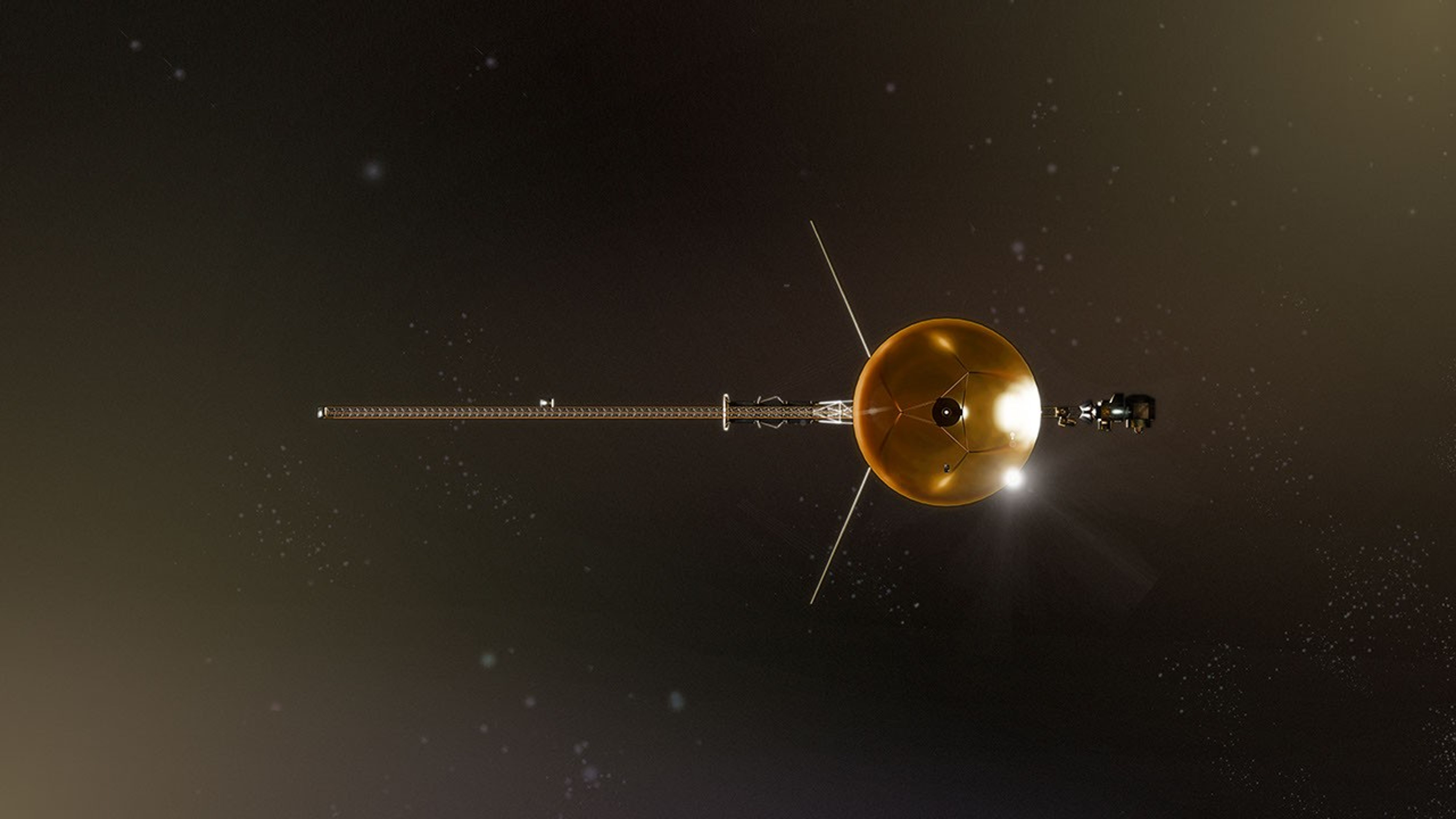
Somewhere out past the edge of the Sun's influence, a machine older than most of the people reading this just crossed a line no human-made object has ever crossed. On Wednesday, November 18, 2026, at 5:16 in the morning Eastern time, NASA's Voyager 1 reached one light-day from Earth — about 16 billion miles away. It is the first thing humanity has ever built to get that far from home.
And here is the part that stops you cold: from now on, it takes a full day just to say hello. A radio signal leaving Earth needs 24 hours to reach Voyager 1. The answer needs another 24 hours to come back. Ask the spacecraft a question on a Monday, and the earliest you hear back is Wednesday.
Voyager 1 at a glance:
| Distance from Earth | One light-day — about 16 billion miles (26 billion km) |
| When it crossed | Wednesday, November 18, 2026, at 5:16 a.m. EST |
| Signal travel time | 24 hours each way — a 48-hour round trip |
| Launched | September 5, 1977, from Cape Canaveral, Florida |
| Speed | About 38,000 miles per hour relative to the Sun |
| Instruments still running | 2 of the original 10 — the plasma wave subsystem and the magnetometer |
| Where it is | Interstellar space, beyond the Sun's protective bubble since August 2012 |
What Is a Light-Day, Exactly?
A light-day is not a unit of time. It is a distance — how far light travels in 24 hours. Light moves at about 186,000 miles per second, so in a single day it covers roughly 16 billion miles. Astronomers would call that about 173 astronomical units. For scale, that is more than four times the distance from the Sun to Pluto. Voyager 1 is now, by that measure, a full day of light away from us.
Why Does It Take Two Days to Talk to Voyager 1?
Because nothing travels faster than light — not even NASA's radio signals. The commands go up through NASA's Deep Space Network, a set of giant antennas that listen for the faintest whisper from the probe, and every message makes the same 24-hour trip. That two-day round trip changes how the mission is run. When engineers at NASA's Jet Propulsion Laboratory send a fix, they wait a day for it to arrive and another day to find out whether it worked. There is no quick check, no instant reply.
The spacecraft itself, of course, notices nothing. NASA is clear that the milestone is symbolic — a mile marker, not a border. Voyager 1 crossed the real border, the edge of the Sun's protective bubble, back in August 2012, when it entered interstellar space.
What Is Voyager 1 Still Doing Out There?
Quite a lot, for a machine running on 1970s hardware. Of its original ten instruments, two are still switched on: the plasma wave subsystem and the magnetometer, listening to the thin gas and magnetic fields between the stars. Its power comes from plutonium-238, and it fades a little every year — about four watts annually — so NASA has been switching instruments off one by one to keep the essentials alive.
It is still moving at roughly 38,000 miles per hour relative to the Sun, heading toward a faint star called Gliese 445. It will pass about 1.7 light-years from that star — in roughly 40,000 years. And it still carries the Golden Record, the gold-plated disc of greetings, music and pictures from Earth, in case anyone out there ever finds it.
What Happens Next for Voyager 1?
NASA marked the moment with a public event the night before, asking people around the world to step outside after sunset on November 17 and flash the letters V-G-R in Morse code with a torch — a small wave to a spacecraft a day of light away. NASA is also holding a live mission update on the twin probes today, Thursday, November 19, at 12 p.m. EST.
The road ahead is simple and extraordinary at the same time: Voyager 1 keeps flying, keeps sending back data from a place no spacecraft has ever been, and NASA keeps listening as long as the fading power allows. Its twin, Voyager 2 — launched 16 days earlier, in August 1977 — will not reach one light-day until around November 2035. Voyager 1 got there first. Forty-nine years after leaving Florida, one light-day from home, still talking.


Comments
Post a Comment